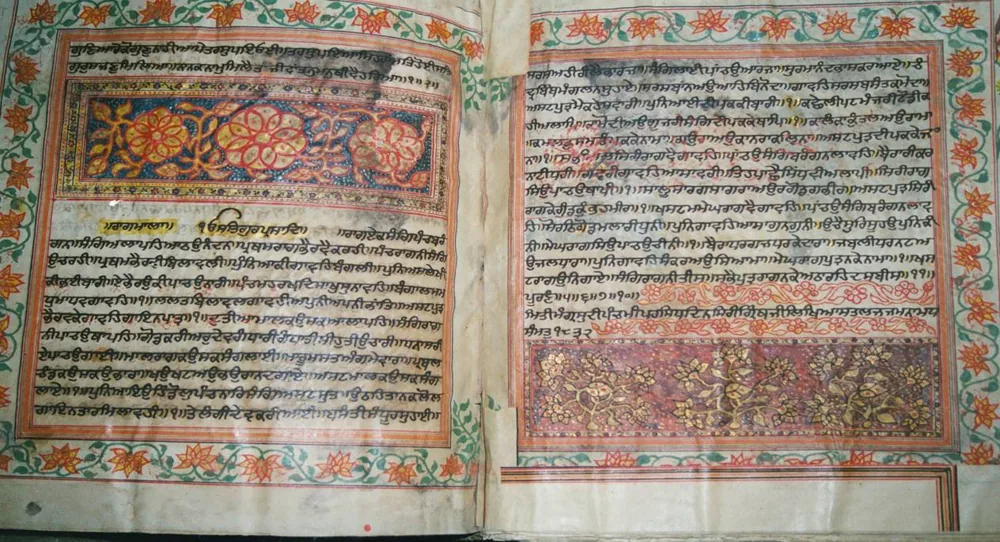
At the end of Sri Guru Granth Sahib Ji, Raagmala brings the reader into a world of musical families. Raags appear with their raginis and sons; names follow names in a compact, patterned composition. For someone expecting a final prayer or a summary of spiritual teachings, this can be an unexpected ending. What is this arrangement doing here, and how should it be read?
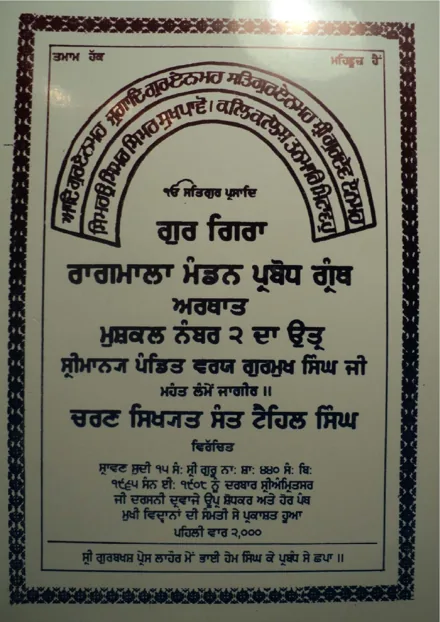
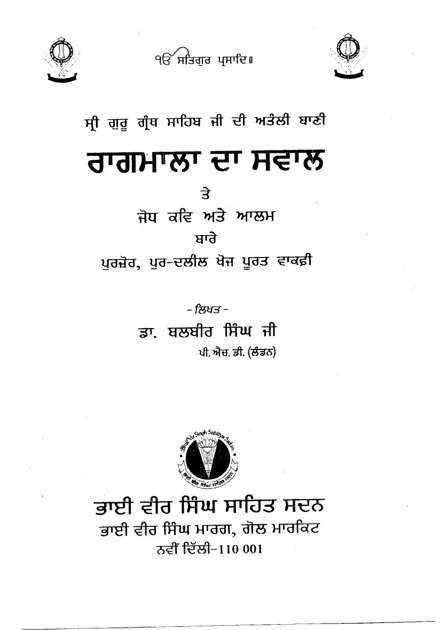
Sant Tehal Singh’s Gur Gira Raagmala Mandan Prabodh Granth and Dr Balbir Singh’s Ragmala Da Swal both approach that question from a firm conviction that Raagmala belongs within the scripture. Their explanations become particularly useful when read together. Tehal Singh introduces the variety of musical classifications and examines the place of musical information within Gurbani. Balbir Singh develops the distinction between different kinds of order and shows why even an apparently simple list of names requires careful interpretation.
Their shared contribution is a way of reading. Before judging Raagmala by what we expect a scriptural conclusion to look like, we need to understand the kind of composition it is.
A family structure for musical knowledge
A raag is a musical mode through which melody is shaped. Raagmala arranges raags through the language of kinship: principal raags, their female companions or raginis, and their sons. The family image gives musical names a memorable set of relationships.
The scheme discussed by both authors has six principal raags: Bhairav, Malkauns, Hindol, Deepak, Siri Raag and Megh. Each is associated with five raginis and eight sons. Its numerical structure is therefore straightforward:1
| Category | Arrangement | Structural total |
|---|---|---|
| Principal raags | Six musical families | 6 |
| Raginis | Five associated with each principal raag | 30 |
| Sons | Eight associated with each principal raag | 48 |
| All three categories | 6 + 30 + 48 | 84 |
The number 84 describes the structure of this classification. Understanding that structure does not require treating each name as a separately measured frequency, or the list as an exhaustive account of every possible musical form. Neither book supplies an acoustic demonstration of that kind. Their discussion concerns names, relationships, musical traditions and the interpretation of a received text.
This distinction makes Raagmala more accessible. A reader can begin by noticing its organisation: six groups, a recurring family pattern, and a language that gathers a large body of musical knowledge into verse. The pattern creates coherence before every individual name has been identified.
It also explains why the terms raag and ragini need attention. Tehal Singh points out that a mode can appear as a raag in a scriptural heading while being classified as a ragini within a musical family. The label depends partly on the system in which the name is being used. A change of classificatory role is therefore something to interpret, rather than an immediate contradiction.2
Why the musical families differ from the scripture’s sequence
One of the objections Tehal Singh addresses begins with an observable difference. The sequence of raag sections in Sri Guru Granth Sahib Ji and the arrangement in Raagmala do not match. Siri Raag opens the scripture’s main raag sequence, while Raagmala begins with Bhairav. Names such as Maajh and Tukhari also raise questions because the scriptural headings and the family list do not provide identical inventories.
Tehal Singh faces these differences directly. His answer is that musical knowledge has been arranged through more than one traditional system. A sequence beginning with Siri Raag and one beginning with Bhairav can reflect different organising principles. He discusses several musical traditions and gives reasons, some musical and some devotional, for the prominence of Siri Raag in the scripture.2
The useful foundation of his answer is the recognition of plurality. It is unnecessary to force Raagmala into the role of a contents page listing every scriptural heading in order. The raag headings organise the placement of hymns; Raagmala presents a family classification. These tasks can produce different arrangements without either arrangement becoming meaningless.
Balbir Singh makes this point especially clear through an analogy from learning Gurmukhi. An alphabet and a pronunciation exercise can arrange related material differently. The order used to introduce letters need not be the order used to practise their sounds. Both can be legitimate because they serve different purposes.3
Applied to Raagmala, the analogy asks the reader to identify the purpose of an arrangement before criticising its sequence. If two lists perform different jobs, matching their first entries is an inadequate test of whether they belong within the same intellectual or religious world.
Here the authors strengthen one another in a precise way. Tehal Singh supplies the discussion of alternative musical classifications. Balbir Singh supplies an explanation of why difference in order does not, by itself, prove inconsistency. Together they answer a mistaken expectation: that everything concerning raags must follow a single sequence.
Musical information has a place within the text
Another objection concerns subject matter. Raagmala names musical forms rather than presenting the kind of direct spiritual instruction readers recognise in many hymns. Can a technical list belong at the end of a sacred text?
Tehal Singh answers by looking at material already accepted within Sri Guru Granth Sahib Ji. Raag headings, ghar designations and instructions concerning tunes help organise the delivery of Gurbani. They do not each function as a complete devotional hymn. Their place is understood through their relationship to the compositions they accompany. His example of the tune instruction associated with Asa ki Var makes the point concrete: musical direction participates in the scriptural setting even when it is not itself an extended statement of doctrine.4
This is a limited but important argument. It defeats the assumption that every element in a scriptural volume must have the same literary form or perform the same immediate function. It does not mean that any musical list can be accepted as Gurbani. Questions of transmission and authority still matter.
Balbir Singh complements this defence through his emphasis on the lived place of music in Sikh devotion. In his opening address, discussion of raag is connected with the experience and practice of singing Gurbani. The musical dimension is part of how the text is encountered, learned and shared.5
Read together, the books encourage a more attentive approach to Raagmala’s subject matter. Its musical vocabulary deserves interpretation within a tradition of sung scripture. A reader’s difficulty in recognising a familiar devotional message is not sufficient reason to treat the composition as alien to that tradition.
Deepak’s eight sons: why counting requires interpretation
Balbir Singh’s final chapter turns this general approach into a detailed reading exercise. Raagmala states that Deepak has eight sons, yet the relevant passage can appear to contain nine names if each apparent name is counted separately. Critics use the mismatch to argue that the text is defective.
Balbir Singh asks how the count has been handled in the very musical literature used to criticise Raagmala. In a chart he reproduces from Bhai Kahn Singh’s work, Kamal and Kusam are treated together as Kamal Kusam, allowing the list to contain eight entries. Another explanation groups Kanra and Kalhana. The real question is therefore how the names should be divided and understood.6
This is more demanding than counting visible word units. Musical names can be compound names, and a compound needs to be interpreted through usage. Balbir Singh discusses the example of Todi Bhairavi to show that a joined name is a recognisable feature of musical classification. He also brings another musical list into the comparison to demonstrate that difficulties in counting are not confined to the scriptural passage.
His most persuasive point is about consistency. If a reader allows compound names or joined forms when interpreting one musical source, the same possibility must be considered when interpreting Raagmala. It would be unfair to explain a difficulty sympathetically in the proposed source text while treating a similar difficulty in scripture as proof of corruption.
The chapter does not provide a reason to join words arbitrarily whenever a total becomes inconvenient. It provides a reason to examine the musical vocabulary before declaring the arithmetic impossible. The interpretation has to be argued, using comparable usage.
This close reading strengthens Tehal Singh’s broader account. Tehal Singh shows why different musical systems can generate different lists. Balbir Singh shows why the internal wording of a particular list also requires knowledge of its conventions. The two defences work at different scales: the arrangement as a whole, and the names within it.
What this changes for a first reading
These comparisons make it possible to approach Raagmala without either reducing it to a bare catalogue or surrounding it with claims the books do not establish.
First, the family pattern offers a clear point of entry. Six principal raags, with recurring groups of raginis and sons, give the composition its visible shape. A new reader does not need to master every disputed name to recognise that design.
Second, the difference between Raagmala and the scripture’s raag headings becomes a question about purpose. One arrangement governs the sequence of compositions; the other presents musical relationships. Their relationship needs explanation, but simple mismatch is not a verdict.
Third, the place of musical information within Gurbani gives a context for the composition’s technical language. Tehal Singh’s examples of headings and tune directions prevent the reader from assuming that devotional meaning must always be expressed in the same literary form.
Finally, Balbir Singh’s discussion of compound names encourages patient reading. What looks like an error may depend on how a phrase has been divided, which version of another work is being consulted, and whether comparable cases are being treated consistently.
Neither musical structure nor literary interpretation alone settles every question about authorship and transmission. Both authors therefore connect these arguments with the evidence of the Birs, the handwritten scriptural volumes discussed elsewhere in their works. The musical argument has its own essential task: it shows why Raagmala should first be understood in its own terms.
Once that happens, the final garland becomes easier to recognise. Its order, its family language and its technical vocabulary form an intelligible composition. The reader can then approach the historical questions with a clearer understanding of the text whose place is being debated.
Source notes: This article uses only the two supplied books. Page numbers refer to their printed pagination; PDF page numbers identify the corresponding pages in the supplied scans. Other works mentioned above are discussed through these authors, not used as additional sources.
Source notes
-
Sant Tehal Singh, Gur Gira Raagmala Mandan Prabodh Granth, pp. 20-23 (PDF pp. 21-24); Dr Balbir Singh, Ragmala Da Swal, p. 198 (PDF p. 204). The total of 84 follows from the stated family structure. ↩
-
Tehal Singh, pp. 20-22 (PDF pp. 21-23), on differing raag arrangements, Siri Raag and the use of raag/ragini terminology. ↩↩
-
Balbir Singh, pp. 9-13 (PDF pp. 15-19), on musical order and the analogy with Gurmukhi letters and pronunciation exercises. ↩
-
Tehal Singh, pp. 23-24 (PDF pp. 24-25), answering the objection concerning Raagmala’s subject matter. ↩
-
Balbir Singh, pp. 9-15 (PDF pp. 15-21), in the opening conference address. ↩
-
Balbir Singh, pp. 198-204 (PDF pp. 204-210), on Deepak’s sons, compound names and comparison with other musical classifications. ↩