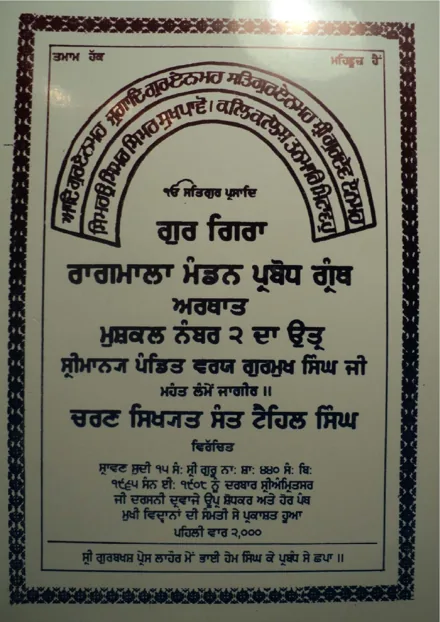
What makes a composition recognisable as Gurbani? A heading? The name “Nanak”? Its position in an authorised manuscript? Or a combination of these features understood together?
Sant Tehal Singh confronts these questions near the beginning of Gur Gira Raagmala Mandan Prabodh. His immediate subject is Raagmala, whose lack of a Mahalla heading and “Nanak” signature had been used to challenge its place in Sri Guru Granth Sahib Ji.
The discussion then moves to Mundavani and the claim that a “seal” must exclude everything written after it. Later, the book describes physical signatures and seals associated with historical birs.
The word “seal” can therefore refer to several different things. Understanding those differences is essential to following the argument.
Four different questions hidden inside one word
Tehal Singh's discussion brings literary identifiers, a concluding composition and manuscript marks into the same defence. They are connected, but they are not interchangeable.
| Feature | What it helps readers identify | The question it raises in the debate |
|---|---|---|
| Mahalla heading | The Guru associated with a passage, through the numerical designation. | Does every accepted composition repeat such a heading? |
| The name “Nanak” | A familiar authorial and devotional signature within Gurbani. | Is its presence compulsory in every individual unit? |
| Mundavani | A named composition near the conclusion of the scripture. | Does understanding it as a seal establish an absolute physical endpoint? |
| Manuscript signatures and seals | Marks attributed to Gurus on particular birs. | What do their attribution, position and relationship to the contents establish? |
An answer about one of these does not settle all the others. A verse's literary signature is not the same kind of evidence as a physical mark on a manuscript. A title interpreted as a seal does not automatically tell us how every historical volume was arranged.
Tehal Singh's response becomes clearer when these questions are considered separately before their evidence is brought together.
The three objections about missing identifiers
The opening group of objections states that Raagmala has no Mahalla heading, does not contain the name “Nanak”, and does not carry an attribution like those associated with the Bhagats or Bhatts.1
Tehal Singh answers the three together. His first move is to examine the rule that the objections assume. If an absent identifier disqualifies Raagmala, must it also disqualify any other composition or passage with the same absence?
He does not need to argue that headings and signatures are unimportant. They plainly help readers navigate the scripture. His narrower point is that their use is not so mechanically uniform that every individual passage can be judged by the same checklist.
This shifts attention from the missing word to the structure in which a passage appears. How large is the unit under consideration? Does a heading identify an entire sequence? Must every smaller unit repeat what its context already establishes?
These are questions about how the scripture is read, as well as how it is attributed.
Japji Sahib tests the proposed rule
Tehal Singh's best-known comparison is with Japji Sahib. He notes that it does not open with a Mahalla heading. He also identifies pauris without the name “Nanak”, including the sequence of pauris 12-14 discussed in his answer.2
The comparison challenges a strict formulation of the objection: every accepted unit must carry the expected heading and signature. Japji Sahib's structure shows that such repetition is not universal.
Care is needed in describing what follows from this. A pauri within a larger composition and a separately titled concluding work are different textual units. The comparison therefore does not prove Raagmala's authorship by itself. It establishes that the proposed signature test needs a more precise explanation.
That is still a substantial result. Once exceptions are acknowledged, absence alone can no longer perform all the work. The discussion has to return to the composition's context, transmission and claimed authorisation.
Tehal Singh supplements Japji Sahib with examples from the saloks associated with Bhagat Farid Ji and from other concluding passages. He draws attention to verses that do not repeat the identifiers his opponents consider necessary.3
These examples extend the same argument across different parts of the scripture. They ask readers to judge comparable features consistently, including when the passage under examination is one they already accept.
A signature is not automatically sufficient either
The reverse comparison is just as significant. Tehal Singh discusses compositions bearing a Mahalla designation or the name “Nanak” that are not thereby accepted as part of the same authorised textual body. Ratanmala is among the examples he invokes.3
His reasoning now runs in both directions. The absence of a marker is not automatically disqualifying, and its presence is not automatically conclusive.
This is why the debate cannot be reduced to counting names. A familiar signature must be interpreted in relation to the whole composition and its transmission. Otherwise, the method would reject accepted passages without the marker while admitting any text that happened to contain it.
Within the book's defence, the historical bir and the Guru's authority over its contents supply the larger context. Tehal Singh regards that context as more fundamental than a rigid expectation about the form of every individual verse.
What the Mundavani objection assumes
The next stage concerns Mundavani. The objection treats it as the scripture's seal and argues that Raagmala stands outside that seal.4
Tehal Singh responds by asking what, precisely, is being identified as the boundary. Is it the heading “Mundavani”? The entire composition that follows the heading? Or a larger group that also includes the following Salok?
The distinction matters because the Salok beginning “Tera kita jato nahi” follows Mundavani. If the presence of a seal forbids all subsequent Gurbani, the following Salok requires explanation too.
This is a consistency challenge. Tehal Singh asks why one accepted composition can follow the supposed boundary while the same position automatically excludes another.
He also pays attention to headings and numbering. The following Salok has its own identity in the arrangement he discusses. It cannot simply be treated as part of Mundavani without explaining that move.
His response does not diminish Mundavani. It questions the inference that revering a composition as a seal necessarily makes its final line the only possible physical end of the volume.
The comparison with Sorath Ki Var
Tehal Singh brings in a passage from Sorath Ki Var associated with Guru Amar Das Ji. It uses the word mundavani and the image of food placed in a platter, while further scripture follows it.4
The comparison lets him ask whether the word always imposes a rule that nothing sacred may come afterwards. If it does not do so there, the proposed rule needs justification when applied to the conclusion of Sri Guru Granth Sahib Ji.
He considers the relationship between the two passages' imagery and meaning. His interest is not merely in finding the same word twice. He wants readers to account for how the word works in its setting.
This argument is sometimes summarised as “Mundavani seals the spiritual teaching, while Raagmala is its musical index”. That neat formula does not fully represent the book. Tehal Singh goes further: he challenges the absolute-boundary reading, discusses variations in manuscript ordering, and himself presents Raagmala as the concluding seal in the arrangement he defends.
The fuller account preserves the actual disagreement. The debate concerns the relationship between meaning, literary placement and authorised textual completion.
From literary seals to manuscript evidence
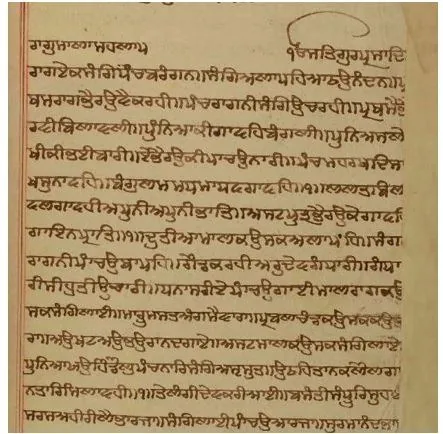
In the final manuscript survey, Tehal Singh describes signatures and seals attributed to the Gurus, and he prints the wording of some of them in labelled boxes.5
This is a different kind of evidence from the name “Nanak” inside a verse. A mark associated with a particular Guru on a bir is used to support the authority of that manuscript and, in the author's reasoning, the contents transmitted within it.
Its evidential value depends on several connected questions: whose mark is it, where is it located, what text belongs to the same stage of production, and what later changes does the volume contain? Tehal Singh frequently connects such marks with his observations about handwriting, ink, indexes and the position of Raagmala.
The book records those claims. Its typeset boxes are representations of the wording attributed to manuscript marks; they are not photographic facsimiles through which a reader can independently examine the original handwriting.
That distinction does not make the descriptions irrelevant. It identifies the evidence accurately: a historical author's account of manuscripts and marks he associates with the Gurus.
Reading the evidence together
Tehal Singh's defence moves from a narrow test to a broader argument. He asks readers to compare the use of headings and signatures, examine the interpretation of Mundavani, and then consider the manuscript tradition in which Raagmala appears.
The strength of the method is its insistence that the same rule should apply to comparable cases. If an absence is tolerated in an accepted passage, it needs more explanation before it can become decisive elsewhere. If a seal permits one subsequent composition, the reasoning for excluding another must be stated.
The book's conclusion remains that Raagmala is Gurbani and belongs at the completion of the reading. Its argument invites a reader to understand authority through the relationships between words, compositions and manuscripts. A missing signature becomes a question to investigate within that whole, rather than a verdict reached before the investigation begins.
Source notes
Sole source: Sant Tehal Singh, Gur Gira Raagmala Mandan Prabodh, 54-page scanned edition. Page references use the PDF viewer numbering, including the cover.
- Objections concerning Mahalla, “Nanak” and named attribution, PDF pp. 16-17.
- Japji Sahib comparison, PDF p. 17.
- Reverse test and additional scriptural examples, PDF pp. 18-19. Verse numbering is not used here for the Farid examples because the discussion follows the numbering printed in the historical source.
- Mundavani, the following Salok, Sorath Ki Var and manuscript ordering, PDF pp. 19-21.
- Manuscript marks and survey, PDF pp. 44-51.