Before Sant Tehal Singh begins his detailed answers about Raagmala, he places a community of readers before the reader of his own book.
The preliminary pages of Gur Gira Raagmala Mandan Prabodh contain statements of support, institutional associations, named signatories and letters encouraging publication. They connect the defence with religious centres, learned individuals, family lineages and people engaged in the everyday work of the Sikh community.
These pages are valuable in their own right. They show how a defence of Raagmala sought a hearing, how supporters described the dispute, and what they hoped publication would accomplish. Their value becomes clearer when each statement is read according to its own wording and scope.
The publication and its appeal for support
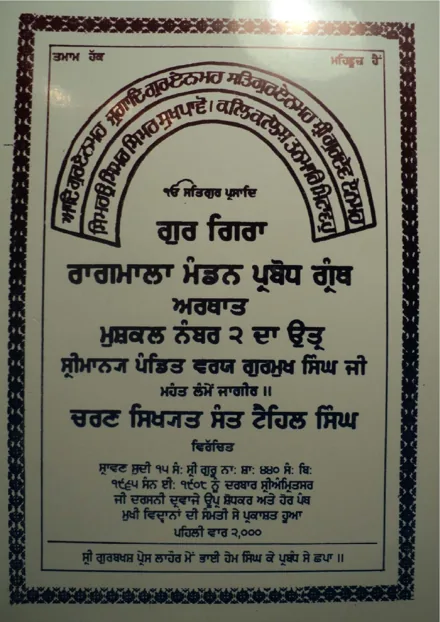
The title page names Sant Tehal Singh and identifies the book as a response to “Difficulty No. 2”. It bears the year 1908, alongside other calendar designations, and records a first printing of 2,000 copies. Sri Gurbaksh Press, Lahore, and Bhai Hem Singh's management are named in the imprint.1
The dated endorsements extend beyond the cover year. Jawahar Singh Kapoor's statement is dated 20 October 1908. Further letters carry dates in December 1908, and the preliminary section includes a statement dated 19 January 1909.
This makes “1908-1909 endorsements” a more accurate description of the material in this edition than a single “1908 verdict”. The cover date and the dates attached to individual statements should both be preserved.
In his opening appeal, Tehal Singh asks learned readers to consider the work and send their opinions. He presents publication as a service to the Panth: doubts should be answered, and the resulting explanation should help the sangat avoid division.
The supporting statements serve several purposes. Some affirm Raagmala as Gurbani. Some say the argument has been read or heard and accepted. Others chiefly encourage printing and circulation. These forms of support overlap, but their wording does not always amount to the same claim.
Support associated with historic religious centres
The preliminary material connects the book with several important locations. Reading the statements together reveals the geographical range of the support assembled by Tehal Singh.2
| Centre or community | What the book records | Why it matters to the publication |
|---|---|---|
| Takht Sri Kesgarh Sahib, Anandpur | A statement supporting Raagmala and a roster beginning with Mahant Natha Singh. | It associates the defence with named religious custodians and members of the Anandpur community. |
| Sri Darbar Damdama Sahib | An approval stating that the work had been heard and accepted, with publication expected to benefit the sangat. | It presents communal reception as well as support for wider circulation. |
| Sri Darbar Muktsar and Tambu Sahib | A supporting statement with printed seal labels and a list including Mahant Pritam Singh and Mahant Bhagat Singh. | It connects the work with more than one local religious establishment. |
| Bhaini Sahib | A statement signed by Pratap Singh affirming the reading of Raagmala and identifying acceptance among the Namdhari Khalsa. | It records a specifically identified community's support. |
| The Bhai Rupa family | A statement that the work had been considered from beginning to end in the presence of Sardar Chanda Singh, a vakil at Ferozepur. | It gives a described occasion and named participants for the review. |
The Anandpur statement refers to manuscript and Guru-associated authority as part of its support. The wording should not be turned into a claim that the original Kartarpur Bir itself was gifted to Patna. References to Kartarpur and to a Guru-associated saroop at Patna need to retain their distinct identities.
The statements also should not be expanded into authority they do not explicitly claim. A published endorsement from people associated with an institution is evidence of that support. It is not automatically a record of a separate, binding decision taken on behalf of the entire Panth.
A network wider than a list of scholars
The numbered roster reaches 131, followed by further written opinions. It includes mahants, gianis, granthis and other religious figures, but also teachers, a lawyer, a press manager, traders and people identified through their locality or family.3
This variety is part of the historical interest. The book's reception extended through educational, religious, commercial and publishing networks. Bhai Hem Singh's appearance connects the list with the practical work of printing. Entries for people engaged in trade connect it with the support of the wider sangat.
It would be misleading to describe every name as an independent scholarly authentication of every argument in the book. The list does not establish that all signatories conducted the same examination. Some appear beneath collective statements; others supply individual explanations of what they reviewed.
The more accurate conclusion is that Tehal Singh assembled a substantial and varied body of support for the defence and its circulation. The document tells us who was represented and, in some cases, how they reached their opinion.
Dr Charan Singh's letter: an important qualification
One of the most revealing passages concerns Dr Charan Singh of Amritsar, whom the book identifies as the father of Bhai Vir Singh.
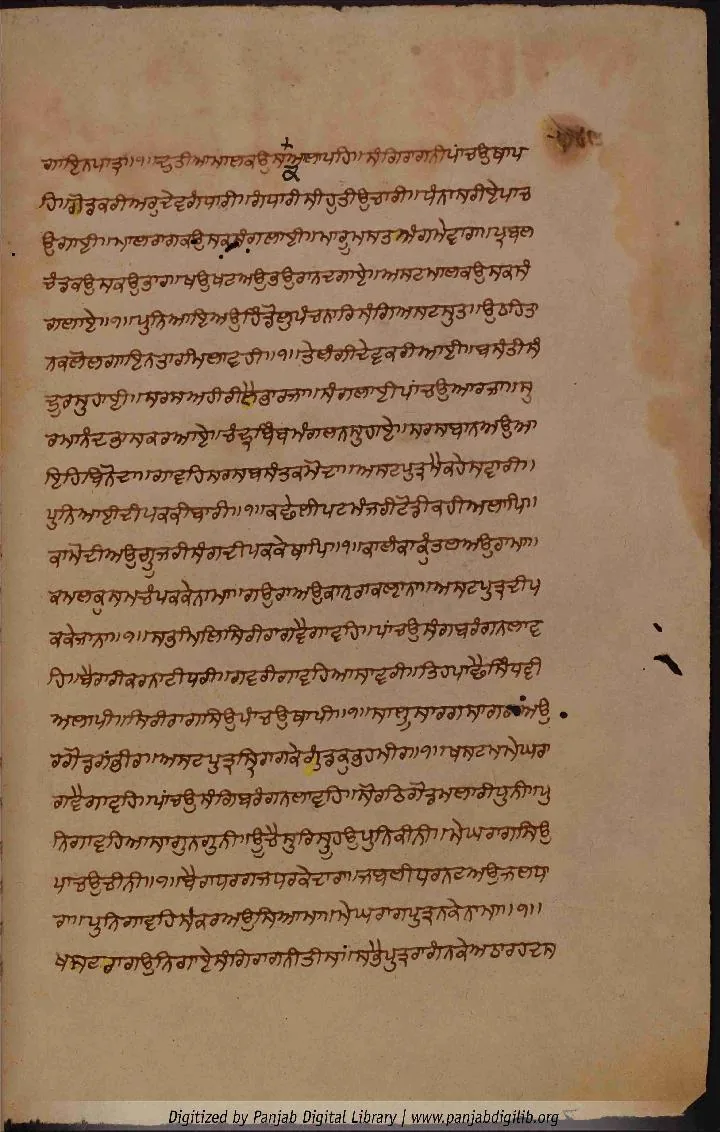
Tehal Singh reports that Charan Singh examined and approved the work and supplied a letter. He then makes a crucial disclosure: the original letter could not be found, and Charan Singh had since passed away. What follows is a recollection of its substance, rather than a verbatim reproduction of the original document.4
Tehal Singh acknowledges that he has not reproduced the entire letter and says he would make it available if it were recovered. He also names people who could speak to the circumstances of the review.
The distinction affects how the passage should be cited. It is appropriate to say that Tehal Singh remembers Charan Singh as supporting the argument. It is not appropriate to present the reconstructed wording as an extant signed letter preserved intact in the volume.
The remembered substance is significant. Charan Singh is represented as believing that the work could answer doubts and reduce discord. Tehal Singh also says that, at Charan Singh's suggestion, he altered some severe expressions and substituted wording more conducive to goodwill.
This records an effort to improve the manner of the defence while maintaining its conclusion. The response to controversy involved editorial judgement as well as the accumulation of arguments.
Kapoor's endorsement makes room for the questioners
Jawahar Singh Kapoor, identified as a Fellow of Punjab University, recommends support for publication and hopes the work will help stop a harmful dispute.5
His statement contains a point easily missed in a triumphal account of the endorsements. The people who raised the questions should not simply become targets of resentment. Their questions had led to the preparation of a work that supporters now considered useful.
This changes the emphasis of the defence. A question can be answered firmly without making hostility towards the questioner the purpose of the answer. In Kapoor's view, the resulting explanation can become a benefit to the Panth.
That perspective sits alongside more combative language elsewhere in the volume. Preserving both gives a better account of the book's reception than presenting every supporter as speaking in one uniform voice.
Some reviewers state the limits of their approval
Sardul Singh Giani is explicit about the scope of his engagement. In his statement dated 25 December 1908, he says that he heard several objections and their answers. Because time was limited, he had not read the whole work. He nevertheless found the answers he heard suitable and favoured publication.6
That is a positive endorsement with a stated limitation. Describing it as a complete, line-by-line examination would erase information supplied by the reviewer himself.
The statement associated with Sant Ishar Singh, a Sikh missionary at Ferozepur, and Bawa Sant Singh likewise contains an important boundary. It expresses agreement on the Raagmala question without necessarily endorsing every other statement in the book.
These qualifications give the reader a more precise understanding of the support. An endorsement can concern the conclusion, the usefulness of publication, or the particular arguments a reviewer has examined. It need not certify every sentence to be historically meaningful.
The Bhai Rupa statement provides a different description: it says that the work was considered from beginning to end in a specified setting. The point is not to force all these statements into one category, but to preserve the differences between them.
What the supporters wanted to protect
A recurring concern is the preservation of the received practice of completing the reading with Raagmala. Supporters also fear that removing one composition could encourage further attempts to cut or rearrange the scripture.56
The argument is both textual and communal. It concerns the integrity of the volume and the relationships of the people who read it together.
Several statements express frustration at the energy being consumed by the dispute. They want thought, learning and effort directed towards service rather than prolonged antagonism. Tehal Singh's closing verses share that aspiration, praying for hostility to disappear and for fellowship to be restored.
The endorsements therefore record more than agreement about a composition. They reveal the kind of outcome supporters sought: an explanation that would reinforce practice, persuade readers and allow the Panth to move forward together.
What this record establishes
The preliminary pages provide evidence of substantial support for Tehal Singh's defence across a range of named people and locations. They also preserve differing degrees of review, a reconstructed letter, explicit limits of agreement and an effort to moderate the language of controversy.
They do not demonstrate that every Sikh agreed, that every signatory independently inspected historical manuscripts, or that the controversy ended because the volume was printed. The book's own discussion of opponents makes the existence of disagreement unmistakable.
Their historical importance lies in what they actually show. A writer sought to defend Raagmala through argument and to place that argument before the community. Religious custodians, scholars and other readers responded. Their names and words became part of the publication's appeal to the sangat.
Read at that level, the endorsements offer a detailed record of how support for Raagmala was expressed, circulated and qualified in the book's own time. Preserving those details honours the witnesses more accurately than turning their statements into a verdict broader than the one they gave.
Source notes
Sole source: Sant Tehal Singh, Gur Gira Raagmala Mandan Prabodh, 54-page scanned edition. All references use PDF viewer pages. Institutional and personal associations are those recorded in the historical volume.
- Title page, publication details and appeal, PDF pp. 1-2; dated statements, pp. 10-11.
- Anandpur, Damdama Sahib, Muktsar, Bhaini Sahib and Bhai Rupa material, PDF pp. 3-9.
- Numbered roster and occupations, PDF pp. 3-9.
- Charan Singh letter, its missing original and the author's reconstruction, PDF pp. 8-9.
- Kapoor, Thakur Singh Giani and Jivan Singh statements, PDF pp. 9-10.
- Sardul Singh and the explicitly limited Raagmala endorsement, PDF p. 11; closing prayer, pp. 51-53.