A missing signature. A musical passage found in another book. An old manuscript with a disputed ending. Each can sound decisive when presented alone.
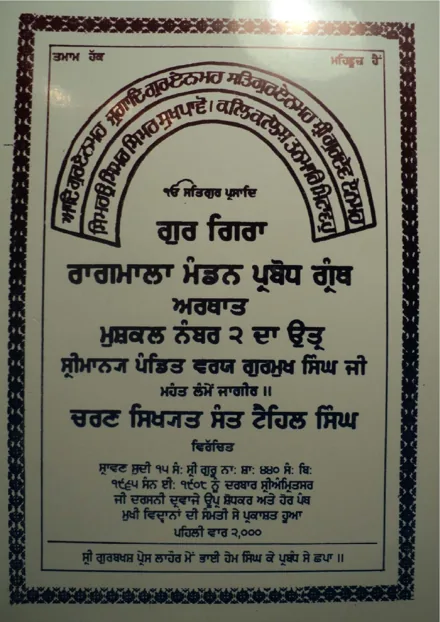
Sant Tehal Singh's Gur Gira Raagmala Mandan Prabodh asks readers to slow down and examine how such claims are connected. Written to defend Raagmala as Gurbani, the book combines close comparisons with accounts of manuscripts, historical testimony and appeals for unity within the Sikh Panth.
Its title page bears the year 1908, and its preliminary material includes endorsements extending into January 1909. The arguments belong to that historical setting. Yet the work remains revealing because it shows how much can disappear when a complicated source is reduced to a few confident claims.
Here are five insights that emerge from reading the book beyond its headline conclusion.
1. A familiar signature cannot do all the work of authentication
One objection to Raagmala is that it lacks both a Mahalla heading and the name “Nanak”. These are familiar features of Gurbani, so their absence appears significant.
Tehal Singh asks a more precise question: are those features compulsory in every accepted passage?
He turns to Japji Sahib. It has no opening Mahalla heading, and a number of its individual pauris do not contain the name “Nanak”. He also examines short passages in other accepted collections that do not repeat the expected markers.1
This exposes a problem with making absence alone decisive. If a rule excludes material already accepted as Gurbani, the rule needs qualification. The relevant questions become the scope of a heading, the boundaries of a composition and the place of a passage within the received text.
The book then tests the opposite assumption. Tehal Singh points to other compositions bearing recognisable headings or signatures whose authority cannot simply be taken for granted. Someone can use a familiar marker; its appearance does not, by itself, establish the origin of the words that accompany it.
These two arguments belong together. A marker can be valuable evidence without being an automatic certificate. Its absence can deserve investigation without proving that a composition must be external.
That is a more useful insight than the slogan that signatures “do not matter”. They matter as part of the evidence. Tehal Singh's objection is to treating them as a universal rule that replaces the rest of the inquiry.
2. Raagmala is more than an ordinary contents page
Raagmala is sometimes explained as a list of the raags in Sri Guru Granth Sahib Ji. The description is convenient, but Tehal Singh's discussion shows why it needs care.
The objection he answers is precisely that the names and classifications do not correspond neatly. Some raags used as scriptural headings are not named in the same way in Raagmala. Some names in Raagmala are not headings in the main arrangement. A form may also be classified as a raag in one context and a ragini in another.2
He does not dismiss the mismatch. He explains it through different musical traditions, including systems associated with Shiv, Hanumat, Bharat and Kalinath. These organise musical relationships differently and can use different names.
The book discusses thirty-one raags in the scripture's main organisation and a broader enumeration of eighty-four raags and raginis in Raagmala. Tehal Singh reads that breadth as meaningful. The concluding composition can express a wider musical order than the set of section headings used earlier in the volume.
He also gives several explanations for the prominence of Sri Raag at the beginning of the musical arrangement. These involve musical precedence, auspiciousness and devotional interpretation. His response allows more than one association to contribute to the placement of a raag.
The result is a richer understanding of the title's “garland”. A garland joins distinct elements into a relationship. In Tehal Singh's account, Raagmala relates musical forms to one another and to the scripture's conclusion. Describing it as a musical catalogue is useful; describing it as an exact table of the preceding contents oversimplifies the explanation.
3. Similar wording does not reveal the direction of borrowing
The proposed connection with the poet Alam is one of the book's most extensive subjects. If comparable words appear in a version of the Madhavanal-Kamkandala narrative, does that show that they were copied into Sri Guru Granth Sahib Ji?
Tehal Singh argues that several steps are missing from that conclusion.
First, the relevant text has to be identified. He discusses different versions and reproduces more than one raagmala. Some passages place musical names within the love-story narrative. A passage associated with Alam resembles the scriptural composition more closely.3
Second, shared musical material must be distinguished from shared wording. Two writers can discuss the same raags because they draw on a common musical classification. A closer verbal resemblance raises a more specific question, but still does not establish which version came first.
Third, the dates and the poet's identity must be established. Tehal Singh challenges the chronology used by opponents and proposes that the transmission could have gone in the opposite direction: from scripture into a later literary work.
His position is a historical argument, with premises that need to remain visible. The existence of a similar passage alone does not prove his proposed direction of borrowing, just as it does not prove the direction proposed by his opponents.
The book's comparison is therefore most valuable when read as a sequence of questions: which version, attributed to whom, dated how, and connected to which manuscript? Removing those questions leaves a much weaker argument, even if the conclusion is expressed more loudly.
4. An index entry matters, but manuscripts have individual histories
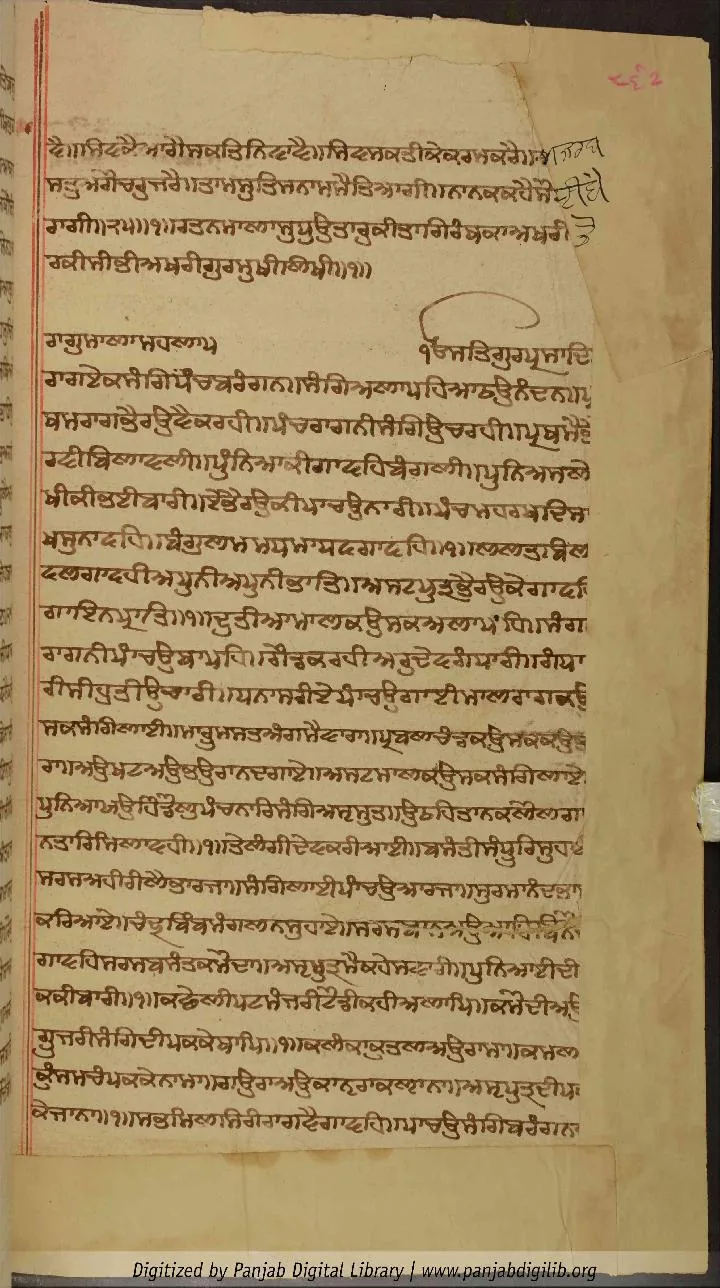
The manuscript survey at the end of the book repeatedly draws attention to the tatkara, or index. Tehal Singh reports Raagmala in the indexes as well as in the concluding text of several historical birs, including the Kartarpur Bir.4
This gives him an argument about the structure of a volume. A composition mentioned in an index has been recognised as part of its contents. If its writing also appears continuous with the surrounding text, that combination challenges the picture of a casually attached extra passage.
The survey contains more detail than a simple list of names. There are accounts of visits, custodians, dates, attributed signatures, rebinding and the later placement of Guru Tegh Bahadur Ji's Bani. Some manuscripts are described as copies of other manuscripts. Several entries concern groups of volumes.
Those distinctions affect how the evidence should be understood. Three copies of the same exemplar show the circulation of that exemplar's text. They do not necessarily provide three independent accounts of its first compilation. A later addition elsewhere in a volume does not, by itself, date Raagmala. An old binding is not automatically the original binding.
Tehal Singh also addresses manuscripts said to lack Raagmala. He interprets those absences through copying errors, omissions and questions about the authority of the copies. The presence of this discussion is significant: the book's defence does not require pretending that no contrary manuscript claim existed.
His case is that the witnesses he considers better authenticated carry greater weight. Understanding why he ranks them that way is more informative than counting every entry as an identical unit of proof.
5. Preserving the order of Gurbani has a religious meaning
Tehal Singh's concern extends beyond the words of an individual composition. He also regards the received arrangement of Gurbani as something a Sikh has a duty to preserve.
To explain that conviction, he invokes a traditional account of Bhai Mani Singh Ji. In the narrative as the book presents it, the scripture was rearranged by author, separating compositions that had belonged within its established musical organisation. The account connects that separation with the imagery of Bhai Mani Singh Ji's subsequent martyrdom, in which his body was cut joint by joint.5
Tehal Singh uses the story to express a correspondence between the integrity of the Guru's scriptural form and the seriousness of dividing it. The arrangement is treated as sacred, rather than as an editor's freely adjustable choice.
The story's role needs to remain clear. It is a religious tradition invoked within the defence, not an independently established historical explanation of the martyrdom. Its purpose in the argument is to make readers understand why alteration carries such gravity for the author.
His comparison with Ram Rai works in a related way. The account of changing scriptural wording illustrates the obligation to remain faithful to the Guru's instruction. Tehal Singh asks why an unauthorised addition of an entire composition would have escaped the concern attached to smaller changes.
These narratives show that his defence has a devotional foundation as well as a textual method. For him, questions of authorship and manuscript transmission lead back to obedience, reverence and the responsibilities of the Sikh reader.
Yet the book also records efforts to prevent conviction from becoming hostility. Tehal Singh recalls Dr Charan Singh encouraging more conciliatory wording, while Jawahar Singh Kapoor sees value in the questions that prompted the defence. The closing prayer asks for enmity between fellow Sikhs to disappear.
Preservation and fellowship are thus connected aims within the work. The author wants the sangat to retain Raagmala and to recover the ability to read, think and act together.
A defence worth reading carefully
Tehal Singh wants readers to accept Raagmala as Gurbani and to complete the scriptural reading with it. The lasting interest of his work lies in the route he takes towards that conclusion.
He asks whether a proposed literary rule survives comparison. He distinguishes musical systems. He tests accounts of borrowing against chronology. He describes the contents and histories of manuscripts. He seeks the responses of other members of the Panth.
Each of these requires attention to detail. The book becomes more informative when its observations, interpretations and devotional commitments remain visible. Its argument can then be understood in its full form, with the care that a discussion of Gurbani deserves.
Source notes
Sole source: Sant Tehal Singh, Gur Gira Raagmala Mandan Prabodh, 54-page scanned edition. References use PDF viewer pages, with the cover counted as page 1.
- Literary markers and counterexamples, PDF pp. 16-19.
- Musical classification and the purpose of Raagmala, PDF pp. 21-25.
- Alam, versions, chronology and comparative passages, PDF pp. 25-35.
- Manuscript objections and survey, PDF pp. 43-51.
- Ram Rai and Bhai Mani Singh Ji narratives, PDF pp. 12-15; Charan Singh and Kapoor material, pp. 8-10; closing prayer, pp. 51-53.