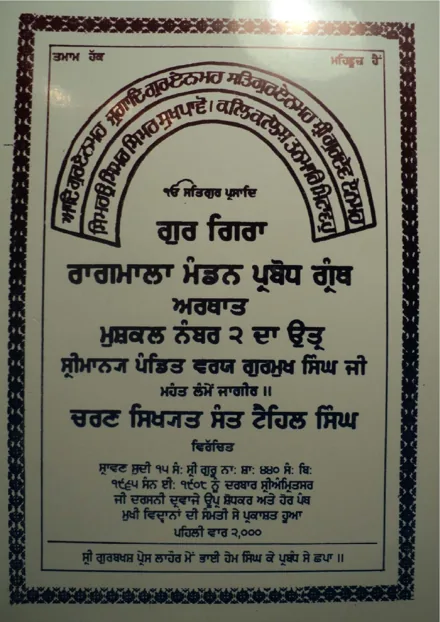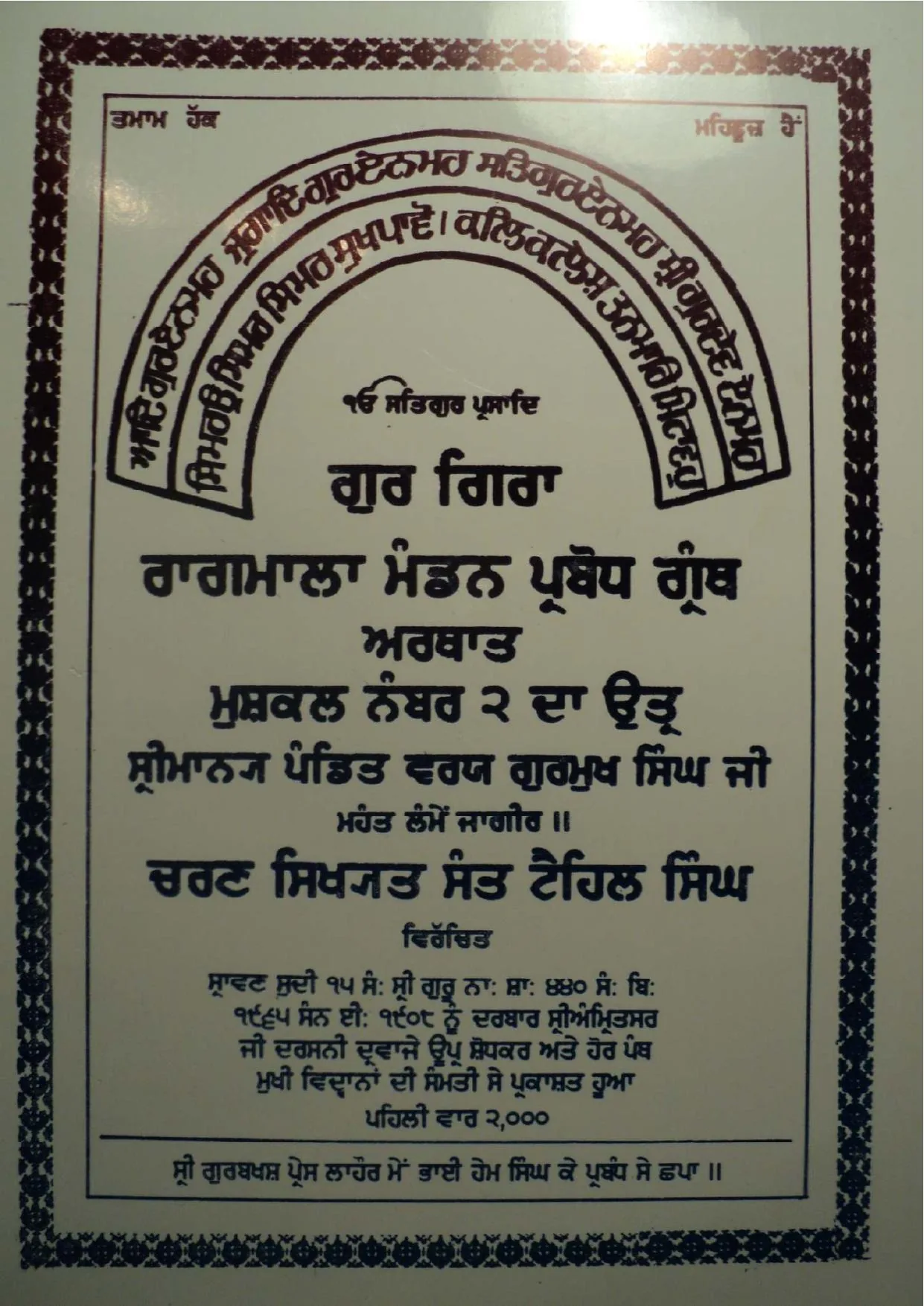
For Sant Tehal Singh, the question of Raagmala was inseparable from a larger responsibility: how should Sikhs receive, preserve and read the scripture entrusted to them by the Gurus?
Raagmala stands at the conclusion of Sri Guru Granth Sahib Ji and describes musical raags through the language of families, companions and descendants. Its position, language and attribution became the subjects of the objections that Tehal Singh answers in Gur Gira Raagmala Mandan Prabodh. His response brings together scriptural comparison, musical explanation, historical writings, manuscript descriptions and the testimony of fellow Sikhs.
The book is an explicit defence of Raagmala as Gurbani. Reading it properly means understanding how that defence works: which objection each answer addresses, what evidence the author presents, and why he believes the disagreement matters to the life of the Panth.
A book written in the midst of a dispute
The title page identifies the work as a response to “Difficulty No. 2”, the Raagmala question in Khalsa Rahit Prakash. Within that larger question, Tehal Singh works through twelve objections. The title page bears the year 1908, while the preliminary endorsements include letters dated in both 1908 and January 1909. The volume therefore preserves a discussion extending across those years. It does not establish that the controversy itself began in 1908.1
The opening prarthna, or appeal, explains the author's immediate concern. Questions about the scripture were spreading through the community, and he feared they would damage the fellowship that Sikh teachers, publications and institutions had worked to strengthen. His image of a carefully gathered community being pulled apart gives the dispute a personal urgency.
The endorsements describe the debate moving through books, tracts and newspapers, as well as conversation. Whether Raagmala should be read at the bhog, the completion of a reading of Sri Guru Granth Sahib Ji, had become a practical question. The argument affected what people did together in the presence of the Guru.
This explains the book's mixture of reasoning and emotion. Tehal Singh believes that an apparently small editorial decision could carry consequences for the authority of the entire received text.
What “Mandan” means in this work
Here, mandan means a defence or vindication. Prabodh carries the sense of clarification or awakening to understanding. The title announces an effort to explain why Raagmala should be accepted and to answer the doubts raised against it.
The structure follows that purpose. An objection, or shanka, is stated, followed by an answer. Verse passages introduce and summarise points; prose develops the reasoning. Readers encounter a sustained exchange with opposing claims, rather than a single uninterrupted declaration of belief.
Tehal Singh also asks readers to weigh the work and send their considered opinion. His preferred outcome is agreement with the defence, but he still wants the argument examined. Several supporters similarly recommend publication because they believe an explanation will benefit the sangat.1
The tone is not consistently gentle. Some passages sharply criticise opponents and their motives. A faithful account should recognise that polemical setting without making the personal accusations the centre of the argument. The book's most useful contribution lies in the questions it asks readers to investigate.
The objections are about different things
One reason the debate can become confusing is that several separate issues are treated as though they were the same question.
An objection about the absence of “Nanak” concerns a literary marker. An objection about Alam concerns authorship and borrowing. An objection about Mundavani concerns the scripture's conclusion. A manuscript without Raagmala raises questions about copying and transmission.
Tehal Singh addresses these through different kinds of evidence:
| Issue | The question being raised | The direction of his answer |
|---|---|---|
| Headings and signatures | Must every accepted composition have a Mahalla heading or the name “Nanak”? | Compare the proposed rule with other accepted passages. |
| Mundavani | Does its position exclude everything that follows it? | Examine the following Salok, related wording elsewhere and manuscript arrangements. |
| Musical classification | Why does Raagmala not reproduce the scripture's raag headings exactly? | Explain different musical classifications and the purpose of a raagmala. |
| Devotional meaning | Can musical names form part of sacred scripture? | Compare musical instructions already accepted within the text. |
| Alam and other literary accounts | Does a similar passage in another work prove that Raagmala was imported? | Examine versions, dates, attribution and competing accounts of inclusion. |
| Manuscripts | What do the presence and absence of Raagmala in particular birs establish? | Consider indexes, handwriting, attributed marks, completeness and copying history. |
The later objections examine the authorities cited in the debate, including Giani Gian Singh's historical writing, Bhai Kahn Singh Nabha's Gurmat Sudhakar, Suraj Prakash and Pandit Tara Singh. Tehal Singh compares their statements with one another and with passages he quotes from Gurbilas Patshahi 6. These are presented as parts of the book's own argument, rather than as authorities all making the same claim.
Answering one objection does not automatically answer every other objection. The book's defence is cumulative: Tehal Singh expects its different lines of reasoning to support one another.2
Why the missing signature is not the whole question
The first three objections concern the absence of a Mahalla heading, the name “Nanak”, and an attribution comparable to those associated with Bhagats or Bhatts.
Tehal Singh responds by asking whether the same requirements are applied consistently elsewhere. He points to Japji Sahib, which does not begin with a Mahalla heading, and to individual pauris that do not contain the name “Nanak”. He also discusses short passages near the ends of other collections.3
The force of the comparison is straightforward. A feature cannot serve as an exceptionless test if accepted scripture contains exceptions to it. A missing marker therefore needs to be understood in context.
He then makes the reverse point: a heading or a sacred name can also appear in a composition whose inclusion is disputed. The appearance of a familiar marker does not settle the entire question either.
His argument consequently moves the reader beyond a checklist. Literary form is relevant, but it must be read alongside the history and arrangement of the composition.
Why the music deserves closer attention
Another objection concerns the relationship between Raagmala and the raags under which Gurbani is arranged. If the two sets of names do not correspond exactly, does that make Raagmala an inappropriate conclusion?
Tehal Singh's answer depends on the existence of different musical systems. He discusses traditions associated with Shiv, Hanumat, Bharat and Kalinath, and the ways names and classifications can vary. A musical form described as a raag in one setting may be placed differently in another.4
He also distinguishes the thirty-one raags used for the scripture's main organisation from the broader musical enumeration he discusses in Raagmala. His explanation therefore gives Raagmala a wider purpose than an ordinary contents page.
That is a useful correction to a common shorthand. Calling Raagmala a “musical index” can help a new reader, but it becomes misleading if it suggests an exact list of the preceding sections in their printed order. Tehal Singh's own response accepts that there is a difference to explain.
The related objection that musical names lack devotional content receives a contextual answer. The scripture already contains musical headings and directions. For the author, these belong to its authorised form even when a reader does not find an explicit statement about the Divine in each individual phrase.
Manuscripts are central to the defence
The final part of the book turns to historical birs, or manuscript volumes of the scripture. Tehal Singh describes Raagmala in the body of manuscripts and in their tatkaras, or indexes. He repeatedly notes what he considers continuity of handwriting and ink, together with marks attributed to particular Gurus.5
Kartarpur occupies a central position because he identifies its bir with the compilation written by Bhai Gurdas Ji under Guru Arjan Dev Ji. He also discusses the Bhai Banno tradition, manuscripts in Rawalpindi and other towns, and holdings associated with Patna Sahib, Hazur Sahib and Amritsar.
An index entry matters to his reasoning because it suggests that Raagmala was recognised as part of the volume's planned contents. Continuity of writing matters because it challenges the suggestion of a visibly separate addition. A history of copying matters because it connects one witness to another.
These are the author's reported observations and interpretations. The scanned book gives readers his descriptions, including printed representations of the wording of certain marks; it does not supply a complete photographic examination of the manuscripts themselves.
The book also acknowledges copies without Raagmala. Tehal Singh argues that these need to be examined for omissions, incompleteness, date and authority. His position is more specific than a claim that every manuscript is identical.
The role of Ram Rai and Bhai Mani Singh Ji
Alongside textual and manuscript arguments, Tehal Singh uses religious narratives to explain the seriousness of changing Gurbani.
His account of Ram Rai centres on the alteration of scriptural wording and the consequences of departing from the Guru's instruction. He also invokes a traditional account linking Bhai Mani Singh Ji's rearrangement of the scripture to the gravity of dividing its established form.6
These narratives express the author's understanding of obedience and preservation. The Bhai Mani Singh Ji account should be presented as a tradition invoked by the book, rather than as an independently established explanation of his martyrdom.
The distinction helps readers see what the stories contribute. They explain why Tehal Singh considers textual arrangement sacred and why he distrusts the idea of an unnoticed, unauthorised alteration being accepted throughout the Panth. They do different work from a dated manuscript description.
The argument ultimately returns to the sangat
The book begins with an appeal to the Khalsa and ends with a prayer that hostility between brothers should disappear. Its historical and literary investigations serve that religious purpose.
There is a revealing example in the preliminary material. Tehal Singh says Dr Charan Singh encouraged him to replace some severe language with more conciliatory wording. Jawahar Singh Kapoor's endorsement also suggests that the people who raised the questions should not simply be resented: their questions had prompted the production of a useful response.7
The defence remains firm. Tehal Singh regards Raagmala as Gurbani and supports its reading at bhog. Yet these passages show that explaining the tradition and preserving relationships were both part of the work's intended service.
For a reader approaching the debate, the book offers a demanding starting point. Identify the precise objection. Read the answer in full. Distinguish what the author witnessed from what he reports or infers. Then consider how the different arguments fit together. That patient approach does more justice to his work than repeating an isolated quotation or declaring the entire question settled by one missing word.
Source notes
This article uses only Sant Tehal Singh's Gur Gira Raagmala Mandan Prabodh, in the 54-page scanned edition. Page numbers below refer to the PDF viewer; printed page numbers are one lower after the cover.
- Cover and opening appeal, PDF pp. 1-2; dated endorsements, pp. 9-11.
- Objection-and-answer sequence, PDF pp. 16-44.
- Headings, signatures and comparison with accepted passages, PDF pp. 16-19.
- Musical systems and devotional-language objections, PDF pp. 21-25.
- Manuscript objections and positive survey, PDF pp. 43-51.
- Ram Rai and Bhai Mani Singh Ji narratives, PDF pp. 12-15.
- Charan Singh and Kapoor material, PDF pp. 8-10; closing appeals, pp. 51-53.